
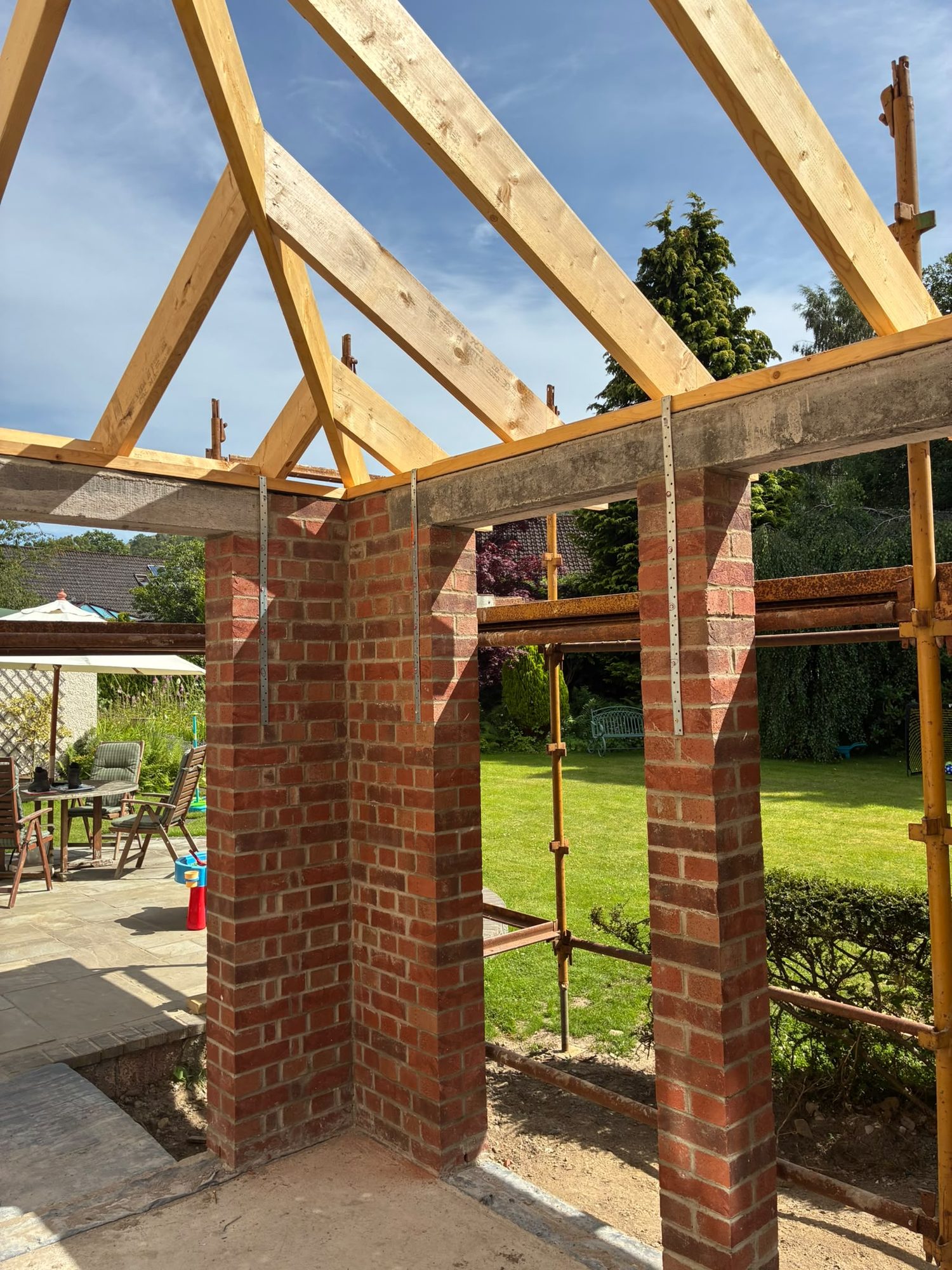
Bricklaying in Aberfeldy & Perthshire
Brickwork built straight,tied in properly,and made to last.
From a new gable to a repaired chimney stack, CG Joinery & Building (Aberfeldy) Ltd lays brick and facing stone to suit Perthshire homes and the weather they sit in.
25 years
Construction experience
Family-run
A personal approach
£2m
Liability cover
One team
In-house & specialist trades
About this service
Bricklaying done by people who answer for it
CG Joinery & Building (Aberfeldy) Ltd is a family-run building firm led by Callum Gilbert, who has 25 years of construction experience behind him. Bricklaying is a core part of what we do on residential work across Aberfeldy and the wider Perthshire area, whether it is a stand-alone job or one part of a larger build.
Good brickwork is mostly about the things you stop seeing once the scaffold is down: a level first course, a consistent bond, wall ties at the right spacing, cavities kept clear of mortar, and damp proof courses lapped and sealed. Get those wrong and the problems arrive years later as cracking, damp patches or staining. We would rather spend the extra half hour on setting out than come back to fix it.
We work with an in-house team and bring in specialist subcontractors where a job calls for them, such as stone masons for traditional repairs or groundworkers for foundations. You deal with one firm, one point of contact and one person who is accountable for the result. The work is residential: houses, extensions, garages, garden and boundary walls, and repairs to older properties.
Many projects start with a conversation about what you want to build and what the site allows. We visit, look at ground conditions, access and the existing building, and then put together a detailed, no-obligation quotation. If your job needs drawings or a Scottish building warrant, we can help with that too through our established architect contacts, with structural engineers brought in where required. We coordinate that process; we are not engineers ourselves.
Perthshire is demanding on masonry. Wind-driven rain, hard frosts and long wet spells all test mortar joints and brick quality. Choosing the right brick, the right mortar mix and the right detailing at copings, sills and openings matters more here than it would in a mild, dry part of the country.
Who it’s for
- Homeowners adding an extension, porch or garage
- Self-builders needing a reliable brickwork contractor
- Owners of older properties needing repointing or rebuilt sections
- Anyone building garden walls, piers or boundary walls
- Landlords and residential owners dealing with defective chimneys or gable ends
- Customers who want brickwork matched to existing walls
Why it matters
Common brickwork problems we are asked to deal with
Most brickwork calls we get fall into a handful of familiar categories. Spotting them early usually keeps the repair smaller and the bill more sensible.
Eroded or recessed mortar joints
Weather and age wear mortar back until water can get into the wall face. Repointing with a mortar that suits the brick and the age of the building stops further damage. The wrong mix can do more harm than good.
Cracking and movement
Hairline cracks may be cosmetic, but stepped cracks following the mortar joints, or cracks that open and close with the seasons, can point to movement. We look at the cause before proposing a repair, and involve a structural engineer where it is warranted.
Spalling bricks
Where the face of the brick flakes off, usually after frost has got into saturated masonry, individual bricks can be cut out and replaced. Matching colour and texture takes care.
Damp around chimneys and parapets
Chimney stacks, copings and parapets take the worst of the weather. Failed pointing, cracked flaunching or missing flashings let water into the building below.
Poorly matched previous repairs
Earlier patch repairs in the wrong brick or a hard cement mortar stand out and can trap moisture. Where it can be improved, we rework it properly.
Common mistakes to avoid
- Using a hard cement mortar on soft older brick or stone, which forces moisture out through the masonry instead of the joints
- Laying brickwork in freezing conditions without protection
- Skipping or mis-spacing wall ties between leaves of a cavity wall
- Letting mortar drop into the cavity and bridge the damp proof course
- Choosing a cheap brick without checking its frost resistance for exposed locations
- Starting work before foundations and levels have been checked and signed off
Our process
How we deliver
your bricklaying project.
Site visit and discussion
We come out, look at the site, the existing walls, access and what you want built or repaired. Photographs, measurements and any drawings you have all help. This is where we spot issues such as ground conditions or difficult access.
Detailed quotation
Use Request a Quote and we will follow the visit with a detailed, no-obligation written quotation that sets out the scope, materials and what is and is not included, so you can compare it properly.
Drawings and warrant where needed
If the work needs plans or a Scottish building warrant, we work with architects and, where required, structural engineers. We coordinate the paperwork and the people. Nothing starts that needs approval until it is in place.
Setting out and building
We check foundations and levels, set out the corners and lay to the line. Bond, cavity widths, ties, damp proof courses and openings are all checked as the wall rises, not afterwards.
Finishing, clean-up and handover
Joints are finished and the site is cleared. We walk through the completed work with you. Defects liability periods of 6 months and 1 year apply on builds, with the terms confirmed for your project.
What you gain
The benefits of doing it properly.
25 years of experience
Callum Gilbert has 25 years in construction, and that shows in the way we plan a wall, handle awkward junctions and deal with problems on site.
Family-run and accountable
You know who is running your job. There is no call centre between you and the person making decisions.
In-house team plus specialists
Our own team handles the day-to-day brickwork. Specialist subcontractors are called in for work such as stone repairs or groundworks.
Insured
We hold £2m public and employers' liability insurance, which is a basic protection you should expect from any contractor working at your home.
Defects liability periods
Builds carry 6-month and 1-year defects liability periods, with terms confirmed per project, so you know what happens if something is not right.
Help with plans and warrants
Established architect contacts and experience with Scottish building warrant applications take weight off you on larger jobs.
In detail
Brickwork in detail: what to expect from a Perthshire job
If you are weighing up a bricklaying project, it helps to understand what actually goes into it. Here is how we approach the main types of work.
Choosing bricks and mortar
The brick sets the look of the building and much of its durability. For new work we talk through colour, texture, size and frost resistance, and where possible we look at samples against the existing house in daylight. Bricks vary from batch to batch, so we mix from several packs as we lay to avoid obvious banding.
Mortar is chosen for the wall, not for convenience. Modern brick can take a standard cement-based mix, but older masonry often needs a softer, lime-based mortar that allows moisture to move out through the joints. Using the wrong one is among the most common causes of damage we see on repairs.
Sand matters too. Its colour and grading change the look of the joint, and a trial panel or small test area is often worthwhile where the match is important.
Extensions and new walls
On an extension, brickwork has to tie into the existing house without creating weak points. We form proper bonding or stainless steel connections where required, detail the junction so water cannot track in, and keep damp proof courses continuous with the existing building.
Cavity walls get wall ties at the specified spacing, cavity trays over openings, weep holes where needed and clean cavities. Lintels are bedded on solid masonry and set level. If the design includes insulation in the cavity, we keep it tight and undamaged as the wall goes up.
Where the design needs structural input, such as larger openings or loads from above, engineers' details are followed on site. We coordinate that with the designer so there are no surprises during the build.
Repointing and repairs
Repointing means raking out failed mortar to a proper depth, brushing the joint clean, dampening the surrounding brick and filling in layers. It is slow, dusty work and not something to rush. Done well it can add decades to a wall.
Where individual bricks have failed, we cut them out carefully without disturbing neighbours and bed in replacements. On chimney stacks we also look at the flaunching, pots, flashings and lead work, since those usually decide whether the repair holds.
If a wall is leaning, bulging or badly cracked, we will tell you honestly whether it needs partial rebuilding rather than patching. In those cases we will explain why and what is involved.
Garden, boundary and retaining walls
Garden walls look simple but they take a lot of weather and no roof to protect them. Good foundations, a damp proof course above ground level, sensible pier spacing and well-fitted copings are what keep them upright and clean.
Retaining walls are different. Soil pressure and water behind the wall can overwhelm poorly designed work, so drainage and engineering input matter. We will advise whether your wall needs design input before we price it.
Working through the Perthshire seasons
Fresh mortar is vulnerable to frost and heavy rain. In cold or wet conditions we cover new work, avoid laying on frozen material and pause when conditions are not safe for the work. That can affect programme, and we will be honest with you about it rather than promise dates the weather will not allow.
Scaffolding, material storage and access are planned in advance, especially on tight village plots or rural sites with narrow tracks. A site visit makes this much easier to sort out before work begins.
Next step
Planning brickwork in Aberfeldy or Perthshire?
Request a Quote and we will arrange a site visit, then send a detailed, no-obligation quotation. We are open Monday to Saturday, 6am to 8pm, on 07584 048096.
£2m public & employers’ liability · 6 & 12-month defects liability on builds · Mon–Sat 6am–8pm